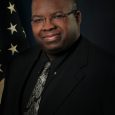
As a Public Information Officer for the Southern Division California Highway Patrol, Rhett Samuel Price became a skilled, respected KABC Los Angeles Channel 7, television and local radio station traffic reporter. Rhett, having delivered traffic reports for eight years, including bilingual Spanish reports for several local Spanish radio stations, developed a gravitas which imparts trust with his delivery. His smooth style inspired high “Q – Score”
television viewer and radio listener ratings for his honest, calm, trustworthiness, and consistent style.
In 1998, Rhett branched out into audiobooks with the assistance of Pat Fraley, Jeffrey Kafer and Scott Brick. Upon separating from the CHP in 2011, Rhett switched gears and applied his vocal talents (not to mention the manners and voices of thousands of people he has met, including celebrities, state and federal dignitaries, numerous presidents, and foreign heads of state) into becoming a versatile and notable audiobook narrator.
He has honed his acting skills through workshops with Steven Tobolowsky, Willie
Garson, VO Peeps’ Anne Ganguzza and Kalmenson & Kalmenson Casting Agency in
Burbank, CA. His audiobook skills have been sharpened through workshops and
seminars with Scott Brick, Jeffrey Kafer, PJ Ochlan, Hillary Huber, and Sean Allen Pratt. Rhett’s most recent work (The Blood of Emmett Till) has been favorably reviewed by Audiofile Magazine, and he receives an average 4.0 or higher ratings on Audible’s website. He is noted for his smooth calm, consistent delivery that is easy and relaxing to listen to over a long period of time.
Not only is Rhett a gifted narrator, he has had the fortunate opportunity to learn audio engineering, recording, and ADR from the versatile Andy Morris of Buzzy’s Recording for two years.
Rhett has narrated for BeeAudio and Curio.io; is listed with Deyan Studios; and has great success on ACX [Audiobook Creation Exchange].
Rhett has been noted as a “sound-a-like” for actors Dennis Haysbert and Keith David.
You used to be a Public Information Officer of the Southern division of the California Highway Patrol (CHP). How did you go from there to becoming an audiobook narrator?
Well, it actually started long before the CHP. During my childhood, I was a voracious reader and was always the one picked to tell stories around the campfire with family, friends and school trips. Telling stories was always a passion for me, but it helped me with my time as a PIO for the CHP. Because of my exposure as a traffic reporter for KABC-TV, Channel 7, and live interviews for various investigations during this time, I was approached often by various people/groups to “speak” at their events. During one such event, I was asked if I was interested in narrating audiobooks. Intrigued with the idea, I took a class with Patrick Fraley and Scott Brick for audiobook narration. Jeffrey Kafer actually recommended me through Pat for my very first audiobook, so I was very lucky, and grateful from the very beginning. As it wasn’t my main job, I worked “sporadically” until I left the department and became a narrator full time in 2015.
What kind of training and experience as a public information officer did you have that has helped you in your second career as an audiobook narrator?
I would have to say being in front of a camera, giving those reports without the aide of a teleprompter, trained me to visualize the scene of the incident and then formulate what I was going to say. In reality, my best training came from working with Nancy Wolfson, Kalmenson & Kalmenson, actor training with Steven Tobolowsky and Willie Garson, audiobook training from Pat Fraley, Scott Brick, Sean Allan Pratt and PJ Ochlan, and my stint as an audio engineer with “Buzzy’s Recording” in Hollywood. I was able to watch and learn from two amazing casting directors, Micah Dahlberg and Matthew Jon Beck, direct the young voice talent for the 2014 Peanuts series. I also was able to work with and see myriad actors (including legends) at Buzzy’s lending their voices to projects while engineering for them, and observing how they worked boosted my confidence in my abilities.
While working for the CHP, you gave reports in Spanish for the Spanish- language outlets. Have you ever narrated a book in Spanish? If not, would you?
While I’m often complimented on my Spanish fluency and and comfortable carrying on a conversation, I would not narrate a book in Spanish. There are too many excellent Spanish actors who would be better suited for the jobs. Why take away from them? But knowing Spanish does allow me to handle a Spanish accent when needed.
You state on your website that you bring with you to your narration “the manners and voices of thousands of people he met including celebrities, state and federal dignitaries, numerous presidents and foreign heads of state.” Who are some of the most famous people you met, and how do you bring them with you?
Oh gosh. This is a HUGE question and answer. I’m afraid I can’t answer it without sound too braggadocio. Let’s just say I was fortunate to have met (and by met, meaning actually having a meaningful conversation about current events or family) numerous heads of state (including US presidents), legislators both state and federal, governors, actors, and luminaries. Of them all, I will say the most interesting was the His Holiness, The Dali Lama, who is a very spiritual, intelligent, yet surprisingly funny leader who weaves a good joke into his teachings. On one particular occasion, while walking to one of His Holiness’ lectures, His Holiness actually caught my arm and kept me from falling while going up the steps at UCLA’s Royce Hall. His Holiness wouldn’t let go until we got to the top. And on the way out, His Holiness grabbed my arm again as we descended to “make sure you do not fall again, hmmm.” Was I ever embarrassed! However it was also humorous in the way His Holiness presented it as protecting me from the UCLA campus. (His Holiness knew I am a USC Trojan.)
I was extremely fortunate and privileged to have had the opportunity to meet them. The opportunity allowed me to really listen in a somewhat safe and “unguarded” presence with no media or unknown people present. They were truly one-on-one conversations that would last with anyone privileged enough, as I was, to have had the opportunity.
But the most interesting people were the people I met day-in and day-out when I worked the highways. Some of my most outlandish and interesting characters are based on real people who I interacted with on a daily basis. So, when I am reading a story line whose character closely resembles someone I may have met, I can reach back to those memories and incorporate them into my reading.
How do you prepare to narrate a book, and what is your process of doing so as you do it?
I read the book first. I made “that” mistake once and found out near the end of the book (like the last ten pages of a 600+ page book) that it was finally said that one of the central characters was Irish, and I had given him a Caribbean accent throughout the book. This was of course before any “formal” training. While reading the book, I look for clues as to the character’s mannerisms and voice from the authors description of them, or from places they may have lived. If I have any questions, I’ll email the author for clarification. Once I’ve read the book, I have a better feel for the author’s style of writing, so it’s a balance between actually internalizing the written words as in memorizing a script, but having the words in front of you as a visual reference to make sure you’re actually saying what the author has written.
Just prior to recording, I brew my cup of Earl Grey Tea (one teaspoon of honey), and skim over the chapter while the tea is brewing to remind myself of the gist of the scene, and then I hit “record” and tell the story. At least every page, I take a sip of tea to keep my mouth moist and my vocal cords hydrated.
Can you tell us about someone whose book you performed who was especially meaningful to you?
I would have to say Sidney Poitier was most memorable thus far. I found it fascinating how he was told over and over again he had no talent for acting. Yet he persisted by going to a theatre house and volunteering to sweep the stage, hallways, and floors for an opportunity to learn acting. He also learned how to read English with the help of a Jewish friend, who taught him to read the newspaper on breaks from washing dishes at a diner where they worked. But what looms large about his life story in my mind was learning that Sidney Poitier was literally afraid to act in front of Spencer Tracy, in Guess Who’s Coming to Dinner. There’s a scene where he first meets Tracy and Hepburn, the parents of his girlfriend, and it looks like they are all in the same room together. They were not. Poitier considered Tracy the greatest actor ever, and he told the director there was no way he could “act” in front of Tracy. So all of his scenes were filmed without Tracy and Hepburn present. They then re-filmed Tracy and Hepburn in the same scenes without Poitier present and spliced the scenes together to make it look like they’re all in the same room. Imagine that! It simply reinforced for me what I had observed about all of the people I talked with above. This was Academy Award winning actor Sidney Poitier showing he was still human and stage frightened nervous in front of Tracy, whom he considered the greatest.
Out of the books that you have performed, which stand out to you as especially memorable?
It’s not listed on my main Audible page because of how the narration credit for my name was done, but it’s The Blood of Emmett Till, written by Timothy B. Tyson. This was a powerful recollection of the lynching murder of Emmett Till. This was 1955, only 63 years ago. Emmett Till’s lynching brought to light the long standing practice of racial bigotry and hatred of Blacks to the forefront of the American conscience. This non-singular incident inspired many of our great Black leaders of the 50’s and 60’s to action and civil rights reform.
In my over a year of recruiting narrators to do interviews like this with me, you are the first African American professional narrator I have encountered (in contrast with authors like Toni Morrison reading their own books). I don’t think I’ve seen any Asian or more than a couple Latinos either. Why do you think there aren’t more African Americans performing audiobooks?
Great question. I am extremely grateful for the many opportunities I personally have had to narrate a plethora of wonderful books. This industry is like any other and you have to be on a casting director’s mind in order to get yourself cast. It doesn’t mean there haven’t been a number of extraordinary Black actors and narrators cast and who work constantly. Robin Ray Eller immediately comes to mind for me, and of course Robin Miles, Dion Graham, Prentice Onayemi, Bhani Turpin (all of whom were recent inductees along with 17 others into Audible’s 2018 inaugural, Narrator Hall of Fame), and Guy Lockard. As bloggers such as yourself discover and interview more and more Black narrators, it will help to bring attention to our work helping to recruit new talent into the fold.
What is the most valuable piece of advice you were given when you started out as a narrator that you like to pass on to new narrators today?
Get a coach! Get a coach! Get a coach! Even though I loved telling stories, learning how to narrate for audiobooks was a steep learning curve. And you never stop learning. There are the rare few who are naturals at it, but you do have to learn this as a business. And if it’s not just a hobby for you and you’re truly serious about narrating audiobooks, then treat it as a business, not a hobby. While this came out “after” I had started this career, I’d have to say Sean Allen Pratt’s video “So you want to be an Audiobook Narrator?” is a must-watch for anyone new. Sean’s description and test best illustrate what audiobook narrators go through on a daily basis. Also, it takes time, practice, and investment to hone this craft. Many people think they can just get a microphone, a computer, or even better, their iPhone or Android and churn out a “Number 1″ best selling audiobook in an hour or two and make tons of money. Let me just say, your chances of winning the lottery are better! Get a coach, learn the steps, consult with an engineer about your equipment, and most importantly, find an area you can convert into a proper recording space. Also, join some Facebook groups to watch, listen and learn.
What is your favorite part about performing audiobooks?
Reading the amazing worlds and characters authors come up with time and time again, and having the privilege to bring those stories and characters to life. I’m currently narrating the first book in a six part dragon series, Rune Scale by Devin Hanson, and I thought I had heard and read it all about dragons, especially with the hit series, GOT, but wow! I was wrong. I’m often enchanted, enthralled or amused, but rarely “Glued” to a story. Without the wonderful work of the authors, all of whom I’ve worked with I would like to personally thank, there wouldn’t be anything to narrate.
Check out Rhett at the following sites:
Rhett’s Audible page
http://www.thevoiceofrhett.com/
Rhett’s Bee Audio page