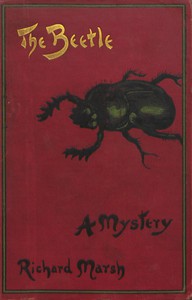
I just finished listening to the audio of The Beetle written by Richard Marsh and read by Nigel Patterson, and it is definitely something for a niche audience–people like me who like looking at early horror and nineteenth century literature. There is some serious atmosphere at the beginning, likely to interest anyone who wants to study horror. It slows after that, and develops some distinct tics.
The Beetle of the title is an elderly individual capable of subjecting others to its nightmare will. It can, and does, change its form from human to beetle with apparent ease. It has come to London to avenge itself on a rising politician by destroying him and his fiancée. The first part is particularly atmospheric and sometimes deeply creepy.
Let’s get one thing out of the way before I continue: Richard Marsh is not even remotely interested in studying other cultures or in doing more than name-checking ancient gods. The titular Beetle is “an oriental” from a “cult of Isis.” This cult is an amalgam of any and all “ancient” cults Marsh can think of or invent. The women kidnap young white men to serve their wicked will. They also kidnap beautiful (presumably virginial) European women, torture them, and burn them to death in front of a figure of the goddess Isis, a vaguely described woman with a beetle on her forehead. This is flat out nineteenth century Orientalism at its height. There will never, at any point, be any slight resemblance to any real “oriental” person or belief, living or dead.
Gender also gets interesting here: Everyone is uneasy around the Beetle in part because no one can decide if the human-form is male or female. The insect form, on the other hand, is easily identified as female. Make of that what you will.
Back to plot and horror:
The Beetle gets off to a creepy start with a young, starving Robert Holt desperately seeking shelter and finding himself in the lair of what he thinks are two distinct creatures. One is an unseen, but heavy, bug with glowing eyes that unnerves him by climbing all over him; the other is a mostly-covered person who quickly places him under its mental control and sends him out to rob the house of an admired politician, Paul Lessingham. Despite his struggles, Holt remains bound to the Beetle’s will and lives through a nightmarish series of days.
It is when the second narrator, Sydney Atherton, takes over that the story begins to slow. In the first place, the tale revolves around his love for Marjorie Lindon, a love neither she nor we believe to be true. Marsh does not trouble to develop their alleged friendship very far, either. This, also, is when characters demonstrate an increasing need to repeat themselves and one another. Conversations begin to read like this:
The night before last, on returning home, I found in my study a stranger.’
‘A stranger?’
‘Yes.—In other words, a burglar.’
‘A burglar?—I see.—Go on.’
He had paused. His demeanour was becoming odder and odder.
‘On my entry he was engaged in forcing an entry into my bureau. I need hardly say that I advanced to seize him. But—I could not.’
‘You could not?—How do you mean you could not?’
‘I mean simply what I say.
One can only hear so many variations of “I mean what I say” before wanting to shake the speaker into elaborating..
There is also some oddly placed comedy. All three of the book’s “characters” appear late in the book and in the middle of a desperate chase. Here, rather than raising the tension or bringing laughter, they simply slow everything down. This, by the way, despite the fact that reader Nigel Patterson renders their dialect more than capably. Had the elderly lady appeared earlier, she would have been a delight. The cabman, too, would have been welcome halfway through the book rather than three-quarters in.
In fact, Patterson’s narration was the chief joy of the book. He managed all the male voices well, and did a superb job of conveying Holt’s growing desperation as he lived under the Beetle’s control. The characters had varied voices, and I loved his way of almost hissing The Beetle whenever the character wished to give his name extra emphasis. Also, I am American, and I love a good British accent.
 The second source of enjoyment for me comes from the fact that I’m at the perfect conjunction of interests for this book: I love nineteenth-century novels, and I have a growing interest in the development of horror literature. This book came out the same year Dracula did, and I had a great time playing compare and contrast with the monsters, the scientists, and the various themes the two share. If you share that eccentricity, you’ll likely also enjoy The Beetle.
The Beetle is published by Raconteurs Audio. You can order a copy from Audible here.. If you want a copy to read, either along side or on its own, you can download one for free from Project Gutenberg.
Here a sample below: